


Darya Majidi, an Italian-Iranian entrepreneur and computer scientist, is a pioneer and visionary in the field of information technology in Italy.
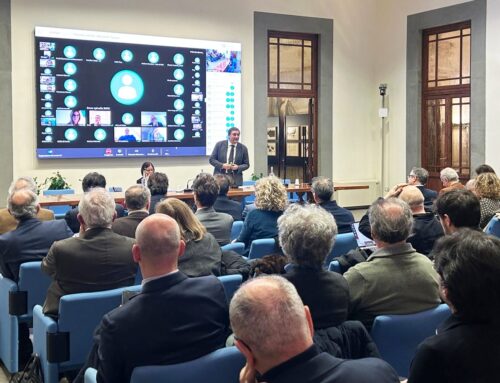
She launched Nexus Digital, a business-matching event organised by the Tuscany Region in partnership with universities, research centres and other stakeholders in the innovation system.
The event took place on 17 November at the Sant’Anna School of Advanced Studies of Pisa. The aim was to showcase regional excellence in the ICT, IoT and Artificial Intelligence sectors and create new opportunities for collaboration between enterprises, spin-offs, start-ups and research organisations.
Dr Majidi, your contribution will open Nexus Digital, the regional event designed to create synergies between universities, enterprises and Tuscan start-ups. In your view, what is the value of initiatives like this for the growth of the regional and national innovation ecosystem?
The Italian economic fabric is made up of small enterprises that often do not have the opportunity to build the important networks needed for growth. Days like this serve to create networking and awareness among entrepreneurs and to learn from one another, trying to draw on each other’s experience.
Speaking of small and medium-sized enterprises, the theme of your keynote at Nexus Digital is “Digitalisation, AI and IoT: key factors for competitiveness in Tuscany”. How can these technologies become real levers of development for SMEs?
When used consciously, digital technologies can bring exponential growth to an enterprise. Consider a traditional company, perhaps in manufacturing and representing the excellence of ‘Made in Italy’, but small in size. If it understands how to use the cloud to increase its visibility or how to use AI to establish a presence on social media and create a distinctive brand identity, it will automatically open up to the global market. However, many of our enterprises remain in their comfort zone, adopting traditional approaches to sales and communication. In such a global and competitive context, it is essential to adopt a digital mindset in order to access international markets. Enterprises must understand that if they do not use these technologies, their competitors will, giving them a significant advantage. When faced with these technologies, enterprises will react in one of three ways: they will either be pioneers and gain a real advantage over others, be followers and wait to see what happens, or be afraid and remain hostile. Enterprises that do the latter will simply become obsolete and disappear.
You have long collaborated with the Sant’Anna School of Advanced Studies, with ARTES 4.0 and with many Tuscan organisations. In your opinion, what are the strengths and weaknesses of the Tuscan system?
The problems lie at a national level. There are no significant investments here. In Italy, securing one million euros in private equity is considered significant, whereas in the United States, the figure is one billion. We really need to understand that funding for these new technologies is essential. Instead, there is a certain fragmentation of opportunities that prevents anyone from truly growing. Italy has important universities and talented young people, yet the data show that 150,000 young people have left in the last three years. Our weaknesses lie in limited investment in research and development, as well as in salaries. A young person in Italy earns 1,500–1,600 euros per month, whereas in the United States, they could earn 6,000–7,000 euros. It is obvious that the most capable people will leave. Therefore, it is the national system that really needs to be updated.
With “Women 4.0”, you have been promoting digital female empowerment for years. Where does Italy stand in reducing the digital gender gap, and what would be needed to enhance female talent in STEM and in technology?
While the number of women in all the other STEM subjects is increasing, we are stuck in ICT (Information and Communication Technology), computer science and electronics. We are at around 17 per cent and cannot grow because universities perpetuate the idea that these subjects are dry and lack a creative dimension. The problem is that the most capable girls are pushed towards the humanities from childhood, while boys are pushed towards engineering. This immediately creates a gap, and as girls grow up, they convince themselves that they are not suited to technological subjects, a notion that is simply nonsense. In my book Donne 4.0, which has now become an association, I proposed that computer science should be a compulsory school subject, studied like physics and chemistry. My message to young women is to never be afraid of these subjects, because you are perfectly capable.
You are a pioneer of Information Technology in Italy, with over thirty years of experience and several start-ups to your name. What has been the biggest challenge in your journey, and what would you advise a young person who today wants to start a technological start-up?
I created my first start-up at the age of 28, as a spin-off from the Sant’Anna School. I later discovered that I was the first woman to establish a spin-off from that institution. The challenges did not arise during the creation phase of the start-up, but during the growth phase. This is precisely because there is an ecosystem that is almost hostile to enterprise growth, with insane bureaucracy and a staggering tax burden. What advice would I give to an aspiring entrepreneur? First, they must understand what they really know how to do and discover their distinctive competencies, turning them into a useful service. If a service is useful, it will sell. Don’t fall in love with the technology or the product itself, but with the usefulness of the service. Adopt a customer-oriented mindset and understand which real need the product or service meets, and then it will sell itself.
Nexus Digital is an event focused on technology transfer. In your opinion, what could really be done to improve this transition from the world of university research to that of business?
There needs to be more interaction between the private and public sectors, more osmosis, if you will. The private sector must be able to invest heavily in university research to bridge this divide. Entrepreneurs who create start-ups or spin-offs are exceptional because they understand both sectors. If they can act as the synapses and neurons that connect the two sectors, then this can work.